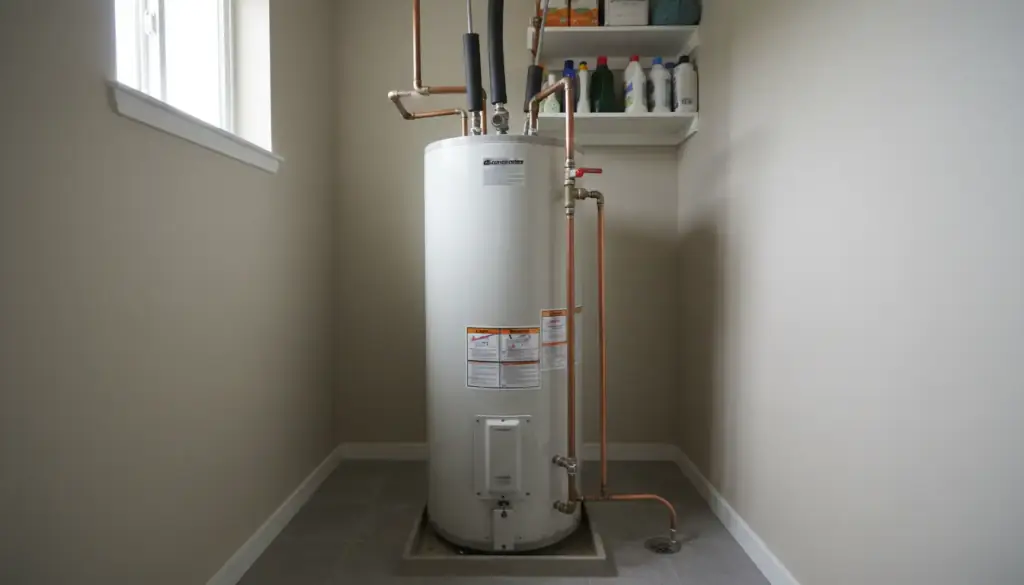
No hot water, a leaking tank, or a heater that quits on a holiday
A water heater rarely fails on a convenient day. The usual signs are lukewarm showers, rust-coloured water, rumbling from the tank, or a puddle at its base. A leak from the tank itself generally ends the repair conversation, while a bad thermostat, element or relief valve can be fixed without replacing the unit.
Ross Z. needed a new water heater over a holiday. Anthony came out on the holiday itself to take measurements, the heater was ordered first thing in the morning, and it was installed that same afternoon. Measuring first matters because tank height, diameter and venting decide which heaters will fit the space.
The shop works across Staten Island, Brooklyn, Manhattan and Queens. Every job starts with an inspection, and the price comes before the work begins.
Tank or tankless: the numbers that decide it
A standard tank stores and heats water in an insulated, glass-lined steel cylinder, typically 30 to 80 gallons. It costs less up front, installs more simply and has easy-to-find parts. The trade-offs are a limited supply when several fixtures run at once, energy spent keeping stored water hot, a bulky footprint and a typical life of 10 to 15 years.
A tankless unit heats water only as it is used, which gives a continuous supply, saves space and typically lasts 20 to 30 years. Three numbers size it: flow rate in gallons per minute (GPM), temperature rise, meaning the gap between the incoming water and the temperature you want, and the ENERGY STAR rating. The costs are a higher purchase price, specific venting, gas and electrical connections, and periodic descaling.
Choose tankless if hot water demand is high, efficiency matters or space is tight. Choose a standard tank if the budget is small, demand is modest and simplicity wins.
A. O. Smith tankless units, and keeping any heater healthy
New York Mechanical installs A. O. Smith tankless water heaters. These are manufacturer figures, not field measurements: the ProLine XE is a condensing model rated up to 0.95 EF, the ProLine XT is non-condensing at up to 0.82 EF, and the Vershine adds Wi-Fi. Inputs run from 19,900 to 199,000 BTU, flow reaches up to 10 GPM, and temperature control holds within about 1 degree F across a 100 to 140 degree F range.
A. O. Smith lists a 6 to 12 year limited warranty depending on the model, plus a 5-year limited labor warranty. Professional installation is recommended for a safe setup, and regular descaling keeps mineral buildup from choking the heat exchanger.
For any heater, the upkeep is short: flush the tank to clear sediment, descale a tankless, and test the temperature and pressure relief valve. Ask about it when you book.